Portfolio / 09 books

Published work

The shelf is the evidence.

Some of these books began as bodies of knowledge, working methods, and research; others as persistent questions, or as stories. Whoever the author, the studio’s job was to help each one find its clearest durable form.

The shelf

Author
Genre

All 9 books

Pick a book and grab your cup of coffee!

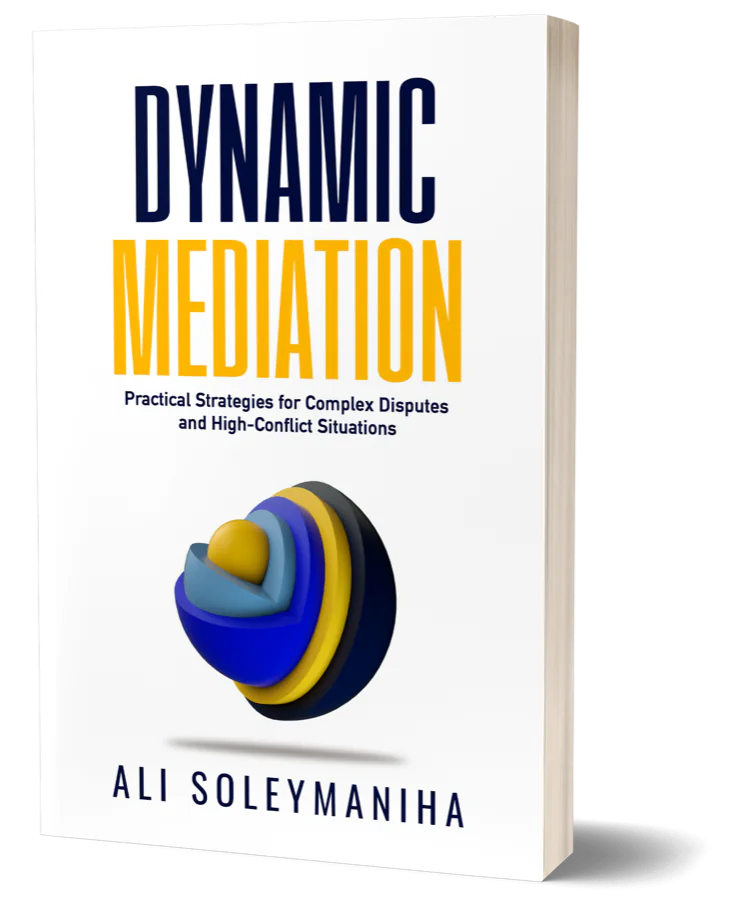
01 / 09 Dynamic Mediation book cover

Professional practice

Dynamic Mediation

Practical strategies for complex disputes and high-conflict situations

A practitioner’s method developed into a clear, usable book for mediators and leaders working in difficult conflict.

Most mediation training still treats a dispute as a problem between two people. This book argues that habit is the limit. It reads conflict as a disturbance in a living system: feedback loops, an equilibrium the parties have lost, and a history that keeps reproducing the fight.

It opens with the debates around Transformative Mediation, then brings cybernetics and systems thinking to the parts of practice that resist a script: learning, emotion, and negotiation. The final chapter assembles the Dynamic Mediation™ model as a five-layer diagram and places every technique on its layer, so theory and practice can be checked against each other.

Inside the book
  • Conflict as disequilibrium, and the work of reaching a new, sustainable equilibrium
  • The five layers of the model: solution building, evaluating progress, collective learning, preferred future, and hope language
  • Feedback, disturbance, and viable systems, brought into the mediation room
Who it’s for
Dispute-resolution researchers, advanced practitioners, and academics who want the theory under the method.
Edition
Published 2022 · Paperback and eBook
Studio contribution

Concept · Manuscript · Editorial · Cover · Production
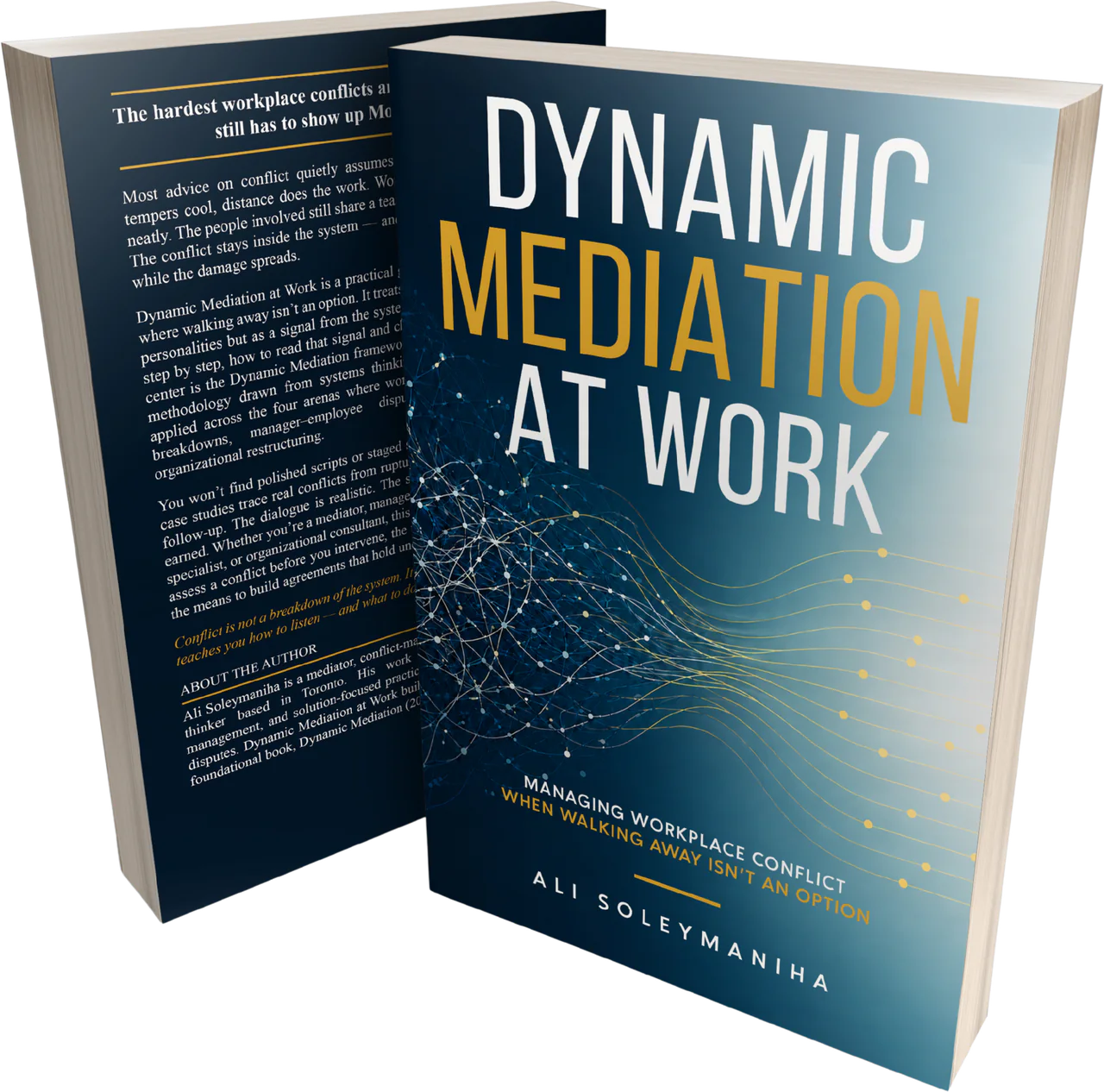
02 / 09 Dynamic Mediation at Work book cover

Workplace leadership

Dynamic Mediation at Work

Managing workplace conflict when walking away isn’t an option

A focused follow-on title that carries a tested framework into realistic workplace cases and decisions.

Some conflicts can’t be ended by leaving. The colleague is still at the next desk on Monday, the grievance is still on file, and the merger still has to work. This is the practitioner’s book of the method, written for the situations HR and managers actually meet, and no prior reading is required.

It walks the Unfreeze, Move, and Freeze process step by step, then takes it into four kinds of workplace dispute, each with its own case study and toolkit. Four running cases carry the argument: a team conflict at Reeves Tech, a promotion dispute, a bargaining impasse between Local 412 and Graystone, and the Meridian Health merger.

Inside the book
  • Part I · Foundations: the workplace as a system, how conflict escalates, and the mediator as change manager
  • Part II · The process: Unfreeze, Move, and Freeze, with workplace scenarios
  • Part III · Applications: peer conflict, management–employee disputes, union grievances, and restructuring
  • Part IV · Mastering the practice: advanced techniques, ethics, and the complete model
Who it’s for
HR professionals, mediators, people managers, labour-relations specialists, and organizational consultants.
Studio contribution

Book architecture · Writing · Editorial · Design · Production

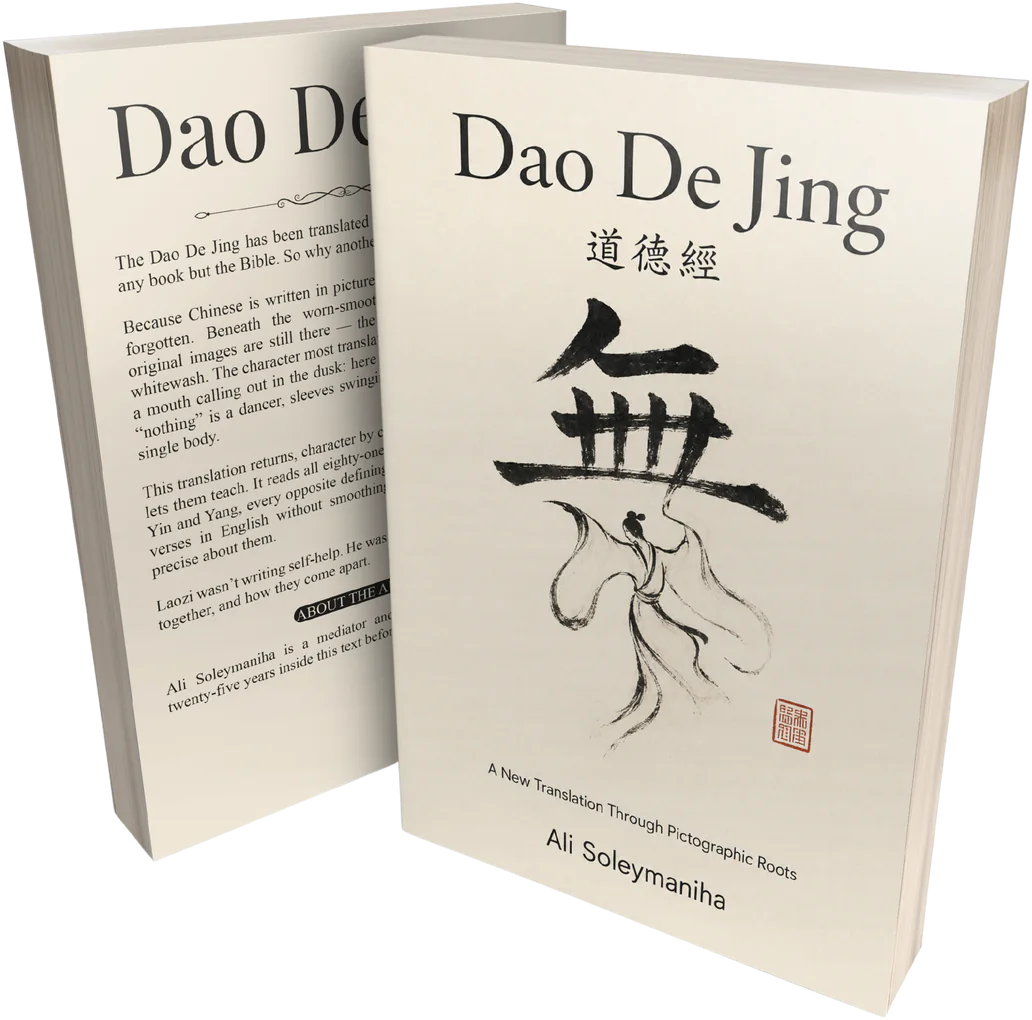
03 / 09 Dao De Jing 道德經 book cover

Translation and commentary

Dao De Jing 道德經

A new translation through pictographic roots

An eighty-one-chapter translation shaped into both a quiet printed edition and an explorable online companion.

Classical Chinese was written in pictures before it was written in concepts. This translation goes back to them. Every character in all eighty-one chapters is followed to the image it began as, and each line is kept close to those images rather than to the abstractions later dictionaries settled on.

The book is the reading edition: the same text in plainer, unhurried English, with the character work pared down to what each verse needs. The full apparatus lives online at Roots of the Dao, where every character is opened to its roots. The site is where you study the roots; the book is where you read.

Inside the book
  • All eighty-one chapters, from “The Gateway to Mystery” to “The More Given, The More Held”
  • A translation read through pictographic roots, not later dictionary definitions
  • A companion website with the full character-by-character study
Who it’s for
Readers who want to slow down with the text itself, and readers who already know another translation and want to hear the images underneath it.
Studio contribution

Research · Translation · Editorial · Cover · Print & digital

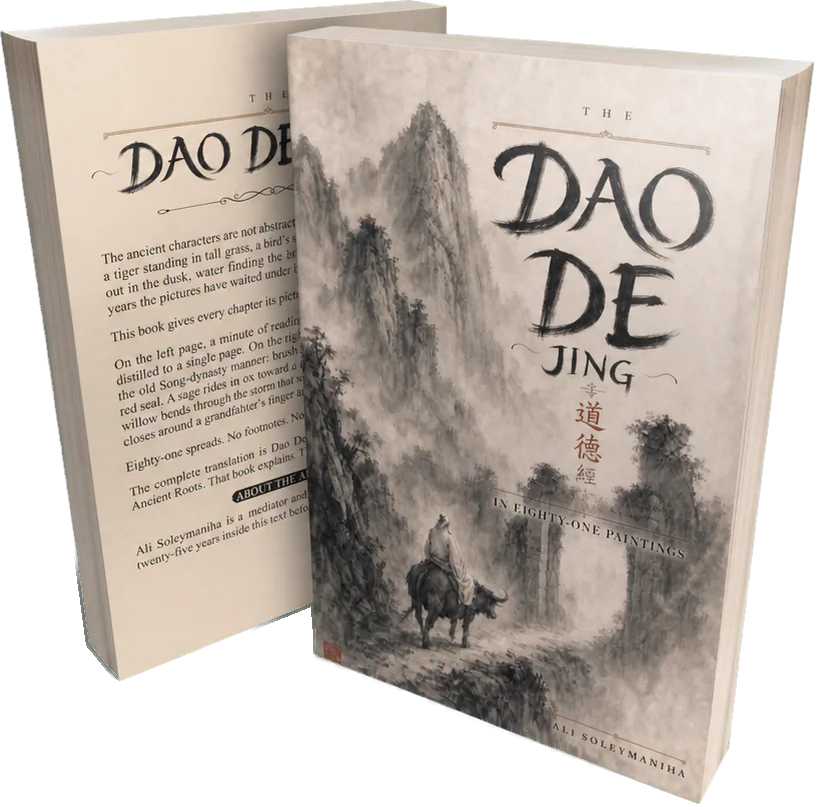
04 / 09 The Dao De Jing in Eighty-One Paintings book cover

Illustrated edition

The Dao De Jing in Eighty-One Paintings

The illustrated edition — one painting for every chapter

A companion to the complete translation, built as a facing-page sequence: each chapter distilled to a single page opposite a full-page painting, eighty-one spreads in all.

A brief edition, made to be read slowly and seen as much as studied. Each chapter is distilled to a couple of paragraphs on the left-hand page, with a full-page painting facing it on the right. Eighty-one chapters, eighty-one paintings.

It draws on the same pictographic translation as the complete edition but asks something different of the reader: not to work through the roots, only to sit with one idea and one image at a time. It works as a first meeting with the text, or as a companion beside the full translation.

Inside the book
  • Eighty-one facing-page spreads, text on the left and painting on the right
  • Each chapter distilled from the complete translation
  • Paintings, layout, and text built as one continuous sequence
Who it’s for
Readers new to the Dao De Jing, and those who know it well and want a way of seeing it as well as reading it.
Studio contribution

Art direction · Illustration · Layout · Cover · Print & digital

05 / 09 Let It Go book cover

Personal growth

Let It Go

A guide to the pain you won’t put down

A structural, case-led approach to what people can’t seem to release — six intertwined stories shaped into one coherent, unflinching book.

“Just let it go” may be the most useless advice ever offered to someone in pain. If they could, they would have. This book starts by taking that seriously. You are not broken; you are stuck, and being stuck has a structure you can see and work with.

Six people carry the argument: Nadia, keeping vigil for a daughter; Marcus, reliving a betrayal; Elena, mourning a life she never got to live; James, serving a sentence of guilt no court imposed; Priya, holding everything so tightly nothing can be set down; and Daniel, whose love has never found its way out of his chest. The book asks no one to minimize the pain or be grateful for it. The pain was real. It is simply not the whole story.

Inside the book
  • Part One · Why You’re Stuck: the loop, the comfort of discomfort, and the stories we tell ourselves
  • Part Two · How to Let Go: six chapters of practical, honest, doable work
  • Part Three · Staying Free: rewriting the story, building a compass, and what to do when the ground shakes again
Who it’s for
Anyone carrying grief, betrayal, regret, guilt, a need for control, or a silence they can’t break. The first chapter is free on the book’s website.
Studio contribution

Concept · Manuscript · Editorial · Cover · Production
06 / 09
Cover in design The Anatomy of Viability Ali Soleymaniha

Management and systems thinking

The Anatomy of Viability

How Stafford Beer saw what management science still can’t

A fifty-year-old model of organizational survival, one invented industrial company carrying the whole argument, and a full apparatus of notes and sources standing behind it. The studio’s work here is the architecture — sixteen chapters and three interludes sequenced so a practitioner can read it straight through and a sceptic can check every claim.

Stafford Beer spent his career on one question: what does any organization need in order to survive? His answer, the Viable System Model, has been sitting in the cybernetics literature for fifty years while management science walked past it. This book takes it out and puts it in front of the people who run organizations.

One invented European industrial company, Meridian Group, carries the whole argument. It starts as a company that did everything right, is taken apart system by system, diagnosed, and finally redesigned. Three interludes follow Beer himself, from the steel mill to Chile to the renunciation.

Inside the book
  • Part I · Why Smart Organizations Die Stupidly
  • Part II · The Anatomy of Viability: seven chapters on the model, from “Where the Work Lives” to “The Scream”
  • Part III · Diagnosis: walking the building, the pathology catalogue, and Meridian redesigned
  • Part IV · The Unfinished Revolution: the question of the next fifty years
Who it’s for
Executives, consultants, and change practitioners who suspect the org chart is not the organization.
Studio contribution

Book architecture · Manuscript · Research · Editorial · Production

In production
07 / 09
Cover in design The Hidden Architecture Alec R. Ashburn

Fiction · The Quiet Game, Book One

The Hidden Architecture

In this world, the most dangerous person in the room is the one who understands you.

A master intelligence officer, a man whose career is built on reading people, falls in love with the one person he never thinks to read. The first of a quiet espionage series set between Singapore, Montreal, and Ottawa, where the tradecraft is real and serves character, not spectacle. Each book stands alone; read together, they hold a second story, so the series had to be built as one structure from the first page.

Daniel is the best source developer his service has ever produced, and his methods are slow enough to frustrate everyone above him. His superior gives him six months to justify them. Then, at a conference in Montreal, he meets a researcher named Lissa Chang.

When his superior disappears during a sensitive operation, Daniel brings Lissa into his world, and her investigation saves a life and changes everything. There is no gunfire and no dead drop; the tension lives in the architecture of trust. Listen for the melody Lissa can’t quite remember the words to. You will want to think about it again.

Inside the book
  • Setting: a hotel bar in Singapore, a conference in Montreal, and Ottawa
  • Tradecraft: real, and patient
  • Reads alone, or as the first in the series
Who it’s for
Readers of John le Carré, Mick Herron, Graham Greene, and Joseph Kanon.
Edition
288 pages · Kindle and paperback · 29 December 2026
Studio contribution

Series architecture · Editorial · Interior · Cover · Print & digital

Out 29 December 2026 Explore this book
08 / 09
Cover in design The Blind Spot Alec R. Ashburn

Fiction · The Quiet Game, Book Two

The Blind Spot

A book about what we decide not to look at, and the trust that is also a choice.

The second novel moves from Montreal and Ottawa to a stone house, and turns the series’ question inward: what we choose not to see in the people closest to us. It reads alone, or after Book One, and carries the hidden thread a step further.

In the wake of Book One, a counterintelligence review finds that someone inside the institution made it all possible. Lissa Chang, newly cleared, builds a tool that reads how people move, not what they access. Daniel is asked to read the people inside the review. The file keeps growing, and some of its pages concern the person he trusts most.

Alongside it runs a quieter story: an old man in a stone house, learning from a wife whose work he was never told about that the warning matters more than the secret.

Inside the book
  • Setting: Montreal, Ottawa, and a stone house
  • The question: what we decide not to look at
  • Reads alone, or after Book One
Studio contribution

Series architecture · Manuscript · Editorial · Production

Written — release date to come Explore this book
09 / 09
Manuscript in progress The Provenance Alec R. Ashburn

Fiction · The Quiet Game, Book Three

The Provenance

A body in Istanbul, a file with the names redacted, and a question of where things come from.

The third book is still on the desk. The studio’s work here is keeping the series’ second story intact as it grows, so a reader who finishes all three can go back and see what was there from the start.

A body in Istanbul. A file in London. A source whose name is withheld. The third book asks where things come from, and what that origin makes them.

Studio contribution

Series architecture · Manuscript development

Being written Explore this book
09distinct publishing journeys
02professional-practice titles
81translated chapters in the Dao De Jing
01studio holding the thread

Add to the shelf

The next finished book could begin with what you already know.

Tell us where you are in the process. We will help you identify the next useful step—without forcing the project into a package it does not need.

Tell us about it